












Introduction
Across Briar Woods, many students are enrolled in AP classes, whether it is their first year taking one or they are balancing three or more at once. As the 2026 AP exams become increasingly demanding, students are rethinking what it truly takes to succeed.
While study guides and practice questions remain important, Briar Woods students say endurance, time management and mental preparation played an equally large role during this year’s exam season. Through interviews with students and teachers, this article explores the emotional and academic experience of AP exams, the strategies students used to manage pressure, and the advice they offer to future AP takers.
Teacher Insights
Ms. Frank, who teaches AP Human Geography and AP Economics, said student challenges varied depending on experience and course structure. In AP Human Geography, many students were taking their first AP exam, which often made the experience more intimidating. She noted that a major challenge was the uncertainty of what to expect and how to review an entire year’s worth of material, which created stress for some students.
In contrast, AP Economics students were generally more familiar with AP exams, but faced different pressures. Since the course includes two separate exams and many students take multiple AP classes, she observed that the bigger challenge was balancing review time across several subjects. Ms. Frank also pointed to disruptions in the school schedule this year, including missed and shortened class days, which compressed instruction and review time.
When asked for advice, she emphasized long-term learning over last-minute studying. She encouraged students to stay engaged in the course throughout the year rather than relying on last-minute cramming, explaining that long-term learning helps students retain information more effectively. She also stressed the importance of understanding the “big picture” of each subject rather than memorizing isolated facts, explaining that both AP Human Geography and AP Economics are built on connected ideas that become easier to understand when seen as a whole.
Student Experiences
Ethan Kimmel
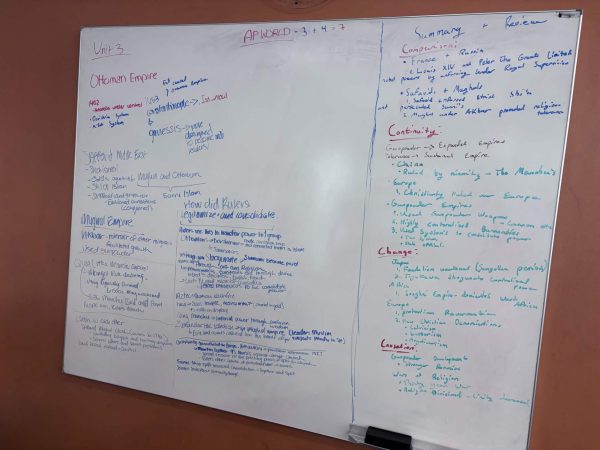
For sophomore Ethan Kimmel, taking AP World History and preparing for his first AP exam, the experience was less stressful than expected. He described studying with friends as one of the most helpful parts of the process, saying it made preparation more enjoyable even when stress was present. He also felt the actual exam was more manageable than anticipated, partly because teachers provided challenging practice materials that prepared students well for the actual exam.
Kimmel’s advice for future AP students was to trust themselves and their preparation. He also recommended using reliable study resources, pacing carefully during the exam, and maintaining basic habits like sleep and nutrition.
Sanjith Katakam
Junior Sanjith Katakam described balancing multiple AP classes as one of the biggest challenges of the year. To manage the workload, Katakam began studying several weeks in advance and dedicated time each day to different exams. As a junior, he said balancing multiple AP classes was one of the year’s biggest challenges. Katakam noted that for him AP Chemistry required the most preparation due to its difficulty and the amount of interconnected content, often requiring a month of consistent studying.
Katakam emphasized that success in AP courses depends on steady effort rather than last-minute studying. He stressed the importance of staying focused in class, taking strong notes and avoiding cramming before exams. He also highlighted that proper sleep and consistent practice were key to performing well.
Managing Academic Pressure
Across both students and teachers, one theme remained consistent: AP exams are not just about intelligence, but about preparation habits over time. Students taking multiple AP classes often faced the challenge of balancing several subjects at once, while others dealt with the pressure of taking their first ever AP exam. Teachers also noted that scheduling disruptions during the school year added additional stress by reducing time available for review. Despite these challenges, students emphasized that preparation strategies like consistent studying, collaborations with peers, and really early review helped reduce pressure significantly.
More Than Just a Score
While AP exams are often viewed as high-stakes academic tests, both students and teachers highlighted that they also reflect broader skills such as time management, discipline and long-term learning.
Rather than relying on last-minute studying, successful students tended to build understanding throughout the year, allowing them to approach exams with more confidence and less stress. In that sense, the 2026 AP exam season was not only about performance, but about how students learned to manage workload, pressure, and expectations over time.