













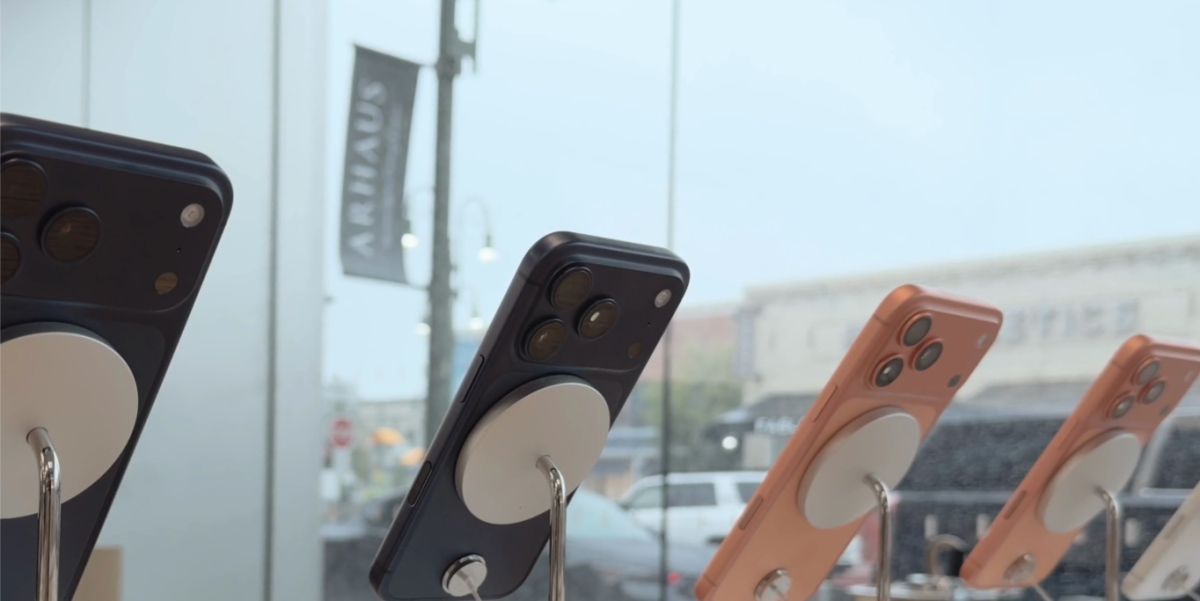

Take a look at the phone caddy on the wall in your classroom, where you’ll see iPhones of every shape and color with the newest addition: the iPhone 17. But here’s the real question, is it worth upgrading when you have last year’s phone?
Every fall, as students swap tank tops for sweaters, Apple announces its latest iPhone. Each new release is described as “revolutionary,” claiming to be faster, smarter, and better than before. But is the iPhone 17 truly a major step forward, or just another way to keep customers chasing the next latest and big thing?
Compared to the iPhone 16, the iPhone 17 does bring several noticeable changes. It features a slightly larger 6.3-inch OLED display with thinner bezels and a 120-hertz refresh rate, making scrolling and gaming smoother. It also includes Apple’s new A19 Bionic chip for faster performance and improved energy efficiency. The ultra-wide rear camera has jumped from 12 to 48 megapixels, and the front camera from 12 to 18 megapixels, while the main 48-megapixel lens remains the same (but in a time where teens prefer the “vintage” look of a digital camera, is a better camera worth it to high schoolers?) The base storage has doubled to 256 gigabytes, and Apple added faster MagSafe charging and better Bluetooth 6 and Wi-Fi connectivity. From the price point of view, the iPhone 16 and 17 start from the same price point, although when the 17 was released, the 16’s price decreased.
For people looking to switch to an iPhone, is it worth it? iPhones do give you a smoother experience, with everything working, and it’s less likely to run into bugs. On the other hand, Androids are more customizable with almost everything: themes, launchers, apps, and more. Plus, Android is ahead of iPhone when it comes to built-in AI tools and options. Though it is important to consider that Apple is becoming more customizable and is working on its AI features.
But what about physical design — is it actually different from older models? Slightly. The iPhone 17 is a little lighter and thinner, with a rounded aluminum frame that feels smoother to hold. The camera bump is larger to fit upgraded sensors, and the phone comes in a new set of pastel finishes and with different Pro colors. Still, at a glance, the regular 17 looks almost identical to the iPhone 16.
“I would consider the new iPhone 17,” said Narsimha Rao, an Application Systems Architect Advisor and author of several cybersecurity articles. “But strategically, I would wait three to six months after launch, when the price drops and software bugs are fixed — or just buy the previous generation at a discount.”
Rao also explains that Apple’s phones are made to last. “Apple devices have strong security, reliable updates, and can perform well for seven or eight years,” he said, pointing out that there is no need to upgrade every year.
Michelle Conley, a marketing education teacher, adds that Apple’s ecosystem plays a big role in its success. “Apple has done a really good job of creating a market base,” she said. “You can move from the iPad to the Apple Watch to the MacBook easily.”
This connection keeps users loyal, and it’s especially visible among teenagers. In many schools, iPhones are practically a social norm — with iMessage, FaceTime, and AirDrop making communication seamless. That popularity can even influence parents to buy one too.
Security is one area where Apple continues to stand out. Rao noted that the iPhone 17 includes better biometric technology and more advanced threat detection that can identify phishing attempts, offering stronger protection for users’ personal data.
From a high-schoolers perspective, security is not their main concern, so what is? Harveer Batth, a ninth grader at Briar Woods says he would consider buying the phone, “probably, because my phone is broken right now, but I also heard that really bad when it [comes to] like the paint jobs.” He continues to explain that he would wait another year, “I think I’d like another year for [the] 18 to get an upgrade”. For many students, the appearance and color of the phone matter, along with the durability of the phone, which many believe the 17 does not have, with its Aluminum build and color choices.
Still, not everything about the iPhone 17 has received praise. Some users are frustrated by Apple’s recent switch to the USB-C charger, which makes their old Lightning cables useless. Others complain that the new aluminum body, while lightweight, is more prone to bending or cracking if dropped. Repair costs remain high, with screen or back glass replacements sometimes costing hundreds of dollars.
So, is the iPhone 17 worth it? It depends. For those upgrading from an older phone — like an iPhone 11 or 12 — the iPhone 17 offers a noticeable jump in performance. But for users who already have a 15 or 16, the changes may not feel major enough to justify the high price tag, which starts around $829. From person to person the verdict may vary, and for a high school student it may not be worth it as new things excite students. But, if you are looking at it from a power user or gamer, with its high battery life it could be a significant change.
Overall, the iPhone 17 continues Apple’s tradition of sleek design and powerful performance. But as many students and tech experts agree, the real question isn’t whether it’s the best iPhone ever — it’s whether it’s different enough to make you buy it.